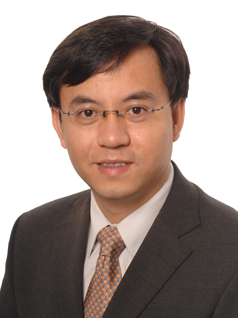
Dr. Billy SC Mak, Associate Professor of Department Of Finance and Decision Science (Economics)
The BUddy Post reporter has interviewed Dr. Billy SC Mak, Associate Professor of Department of Finance and Decision Sciences. Dr. Mak is alumnus of Economics (1989) who would share with us his life as a student and as an academic staff in HKBU, his hobbies as well as his views on the current financial situation.
Reporter: What was your ideal profession when you were young? Why did you choose to study Economics?
Dr. Mak: I did not think about my career when I was small. In secondary school, I took arts and business subjects including Chinese Literature, History, Economics and Accounting. The 80's was a decade of industrial and commercial development and the world was divided into two mainstreams -- the Capitalist world represented by the U.S. and the Socialist world led by the then U.S.S.R. As a secondary school student, I was deeply interested in the political, social and economic impacts of these two ideologies and therefore I decided to take Economics at HKBU after my A-level exam.
Reporter:Could you share with us some interesting stories during your study in HKBU?
Dr. Mak: To me, the most memorable moment was the time when I and my classmates kicked shuttlecock at the open area outside the snack shop named Panorama on the top floor of the then CS Tse Memorial Hall (now Cha Chi-ming Science Tower). During my study, the teacher-student relationship was very close and they would greet every passing-by students.
Reporter: When did you begin to teach in the Department of Finance and Decision Sciences? Could you share with us the joy of teaching/working in HKBU?
Dr. Mak: In 1989, I went to the U.K to study for my master's degree. After graduation, I came back to HKBU to visit my teacher who told me that there was a vacancy of a short-term Assistant Lecturer. And so I am here, and for 21 years now since 1990. Looking back, Shaw Campus (the then Government Supplies Department) was still under construction and the students had to study under "tin roof". Many of our Business School teachers have experienced this too. It just can't be compared with the campus facilities that we can enjoy today.
Reporter: Being a financial expert, how do you see the debt crisis in Europe?
Dr. Mak:The financial crisis in Europe has its root in welfare-ism of the European countries which require huge amount of government expenditure to pay for. Yet, with an aging population and reduction in working population and therefore tax income, there is simply not enough money. The governments therefore have to issue Government Bonds to raise funds. At the moment, there is quite a lot of skepticism as to whether countries like Greece and Spain, can afford to repay the debt. The sovereign debt crisis in Europe is not confined to a single country. Many European countries are indeed in the same situation. Though they are desperate for a solution, it is doubtful if it is possible for all to be able to agree on a plan very quickly to end this crisis given the vested interest for each and every country is different.
However, with the experience of the 2008 Financial Tsunami, governments and investors alike are now better prepared. I think the sovereign debt crisis will be resolved over time. As for individual investors, it is important to manage your own risk and there is not much that one can do about it.
Reporter: Given the current economic situation, could you share with us some investment advice? Cash is King?
Dr. Mak: The global economy is deteriorating and under gloablisation, Hong Kong will undoubtedly be affected. The HK stock market is therefore also having a downturn/decline reflecting some external factors affecting the world economy. But given that Hong Kong has good fundamentals such as low unemployment rate and strong back-up from the Mainland, the outlook is not too gloomy. As to whether "cash is king", it depends. If the investment portfolio is for the long-term such as for retirement planning purposes, then short-term fluctuation of the prices does not matter that much. In fact, this may not be a bad time to “buy” to average the cost down for your investment portfolio. On the other hand, if investors are for the short-term, they can sell those that are still profitable, keep the cash and buy in quality assets when the market hits bottom.
Reporter: What are your hobbies? How do you relax yourselves from work pressure?
Dr. Mak: I have keen interest in doing research in socio-economic issues. Apart from teaching and conducting research at the University, I also take up some voluntary work. I am a co-opted member of the Urban Renewal Authority Finance Committee; Honorary Advisor of the Hong Kong Institute of Investors; member of the Hong Kong Securities Institute; and the examination reviewer of the Institute of Financial Planners of Hong Kong. With these voluntary works, I can apply what I have learned.
My interest in wine was developed when I studied in the U.K where they have a "pub culture". That time, our professors would invite us for a drink at the pub after class to continue the academic discussions or to talk about world affairs in a relaxed environment.
I also like drinking tea, in particular, Pu Er Tea. I also like collecting Chinese antique tea-wares from the civilian kiln. They may not be as valuable as those from the official kiln and you can find them from the antique market in Sheung Wan at less than a hundred dollars. However, the price does not reflect its collection or artistic values. Imagine when you are holding a tea-ware from the Sung Dynasty, you will feel like interacting with people 800 years ago.
In recent years, I have developed much interest in history and antiquity. Therefore, I visited different museums and exhibitions when travelling. History reflects human behaviours. Understanding history helps me understand human behaviours better in the society.
Reporter: Could you recommend some good red wine to our alumni?
Dr. Mak: It depends on your budget. The simple way is making a choice between the "New World" and the "Old World". If your budget is HK$300 or below, you can choose the wines from Australia or Chile. For budget over HK$300, those from Bordeaux and Burgundy would be fine. Wines from the European "Old World" are usually more complex and elegant while those of the "New World" are more pleasing. It is hard to say which one is better. It all depends on your taste. For sure, the year, the origin, the region and the category should also be considered when it comes to valuation of wines.
Reporter: Do you "wine" everyday?
Dr. Mak: To me, wine tasting, in particular, tasting fine wine is a happy moment which should be shared with friends. I seldom drink on my own. When tasting fine wine, each sip gives my taste bud a different sense and a different meaning. I will also think of the historical background when I think of the vintage years and regions. For example, I will think of the joy of the French farmers after the end of the 2nd World War when I drink the French red wine of 1945.
Red wine is also a good topic for business conversation. It is helpful for developing interpersonal relationship. I always encourage my students to enrich their wine knowledge if they are interested in it.
Reporter: What are your mottos in life?
Dr. Mak: You can never please the whole world, so it is more important to live with a clear conscience.
Interviewees’ Biography:
| Dr. Billy Mak |
|
|
|
|
Dr. Billy Mak is currently the Associate Professor of the Department of Finance and Decision Sciences, Associate Programme Director (Outreach) of Master of Business Administration and Member of the Hong Kong Securities Institute. His research topics focus in financial management, investment management, derivative securities and financial planning. He has authored numerous publications and papers on the equity market and investment. Dr. Mak is frequently interviewed by the media on economic issues and he is also a freelance writer in newspapers on financial and economic issues. Dr. Mak is a co-opted member of the Urban Renewal Authority Finance Committee, member of the Investor Education Advisory Committee (IEAC), member of Academic and Accreditation Advisory Committee, member of the Advisory Committee on Human Resources Development in the Financial Services Sector (FinMan Committee) and member of Hong Kong Gold and Silver Exchange Registration Committee. |
|