



People・Inspiration
HKBU has nurtured over 178,000 graduates since its inception in 1956 and a lot of alumni have inspiring career journeys in diverse areas and professions. We are delighted to introduce these promising alumni and invite them to share their career aspirations and journey with us.
Alumna Joy Qian Xiaole
Breaking Boundaries: Cross-Industry Career and Entrepreneurial Journey

Alumna Joy Qian Xiaole
(Photo Credit: Alumna Joy Qian Xiaole)
Graduated from Master of Arts in International Journalism Studies programme of HKBU, alumna Joy Qian Xiaole (Communication–Journalism) has built a dynamic and cross-disciplinary career defined by continual learning and growth. After starting as a journalist at Xinhua News Agency, Joy transitioned to marketing strategy and consulting international firms like Weber Shandwick and PwC, and later led cross-regional e-commerce teams at Klook. Most recently, as Associate Director of User Growth at AlipayHK, she focused on e-commerce and user growth, which broadened her international exposure.
Beyond her corporate roles, Joy co-founded a startup that received support from New World Development’s “A. Entrepreneur Adventure Programme” and the Cyberport Creative Micro Fund, gaining valuable entrepreneurial experience. Throughout her journey, Joy has remained committed to proactive learning, self-exploration, and maintaining a positive mindset. Her experiences highlight the possibilities of diverse career paths and offer inspiration to students and alumni exploring their future.
1. After graduating from the journalism programme, you went through several industries, from journalism to marketing strategy and e-commerce. Looking back on this journey, what are the key skills and mindset that have consistently empowered you to navigate such a diverse career path? Could you share a specific lesson or value from your HKBU days that has directly contributed to your professional growth or helped you stand out in competitive environments?
Reflecting on the past decade, three skills and one mindset have consistently helped me navigate across industries from journalism to marketing strategy and e-commerce.
First, the ability to see things from others’ perspectives and ask the right questions. Understanding what audiences, customers, or stakeholders truly need is crucial. As a social media strategist, it meant turning messy briefs into messages people cared about. As a digital product manager, it meant running user interviews to uncover real problems. My journalism training cultivated me to be curious, listen carefully, and keep asking “why” until I found actionable insight.
Second, logical and structured thinking. In the digital and tech space, you’re constantly diagnosing problems, proposing solutions, and validating results. Approaching problems like a reporter—defining the question, gathering evidence, challenging assumptions, and building narratives from facts—has strengthened both my decision-making and clarity of communication especially in fast-moving environments.
Third, clear and human communication. It is a talent to be able to express ideas simply (without oversimplifying). It builds trust, aligns teams, and saves time—qualities valued in any workplace.
Beyond skills, one mindset stands out: face the fear and keep going. I’ve often worked on “new things”— platforms, features, initiatives—which are exciting, but also uncertain and sometimes risky. Over time, I learnt that growth requires stepping outside the comfort zone, and sometimes that means facing discomfort or even pain. At that moment, it is necessary to take a deep breath, encourage yourself and give yourself the courage to face challenges. By staying humble and continuously learning, you can keep making progress.
From my HKBU days, one value has shaped my professional growth: be fact-driven, yet empathetic and responsible. Grounded in evidence and logic, I remain mindful that real people are behind every story, dataset, or product decision, guiding me to create meaningful impact while staying true to my values.
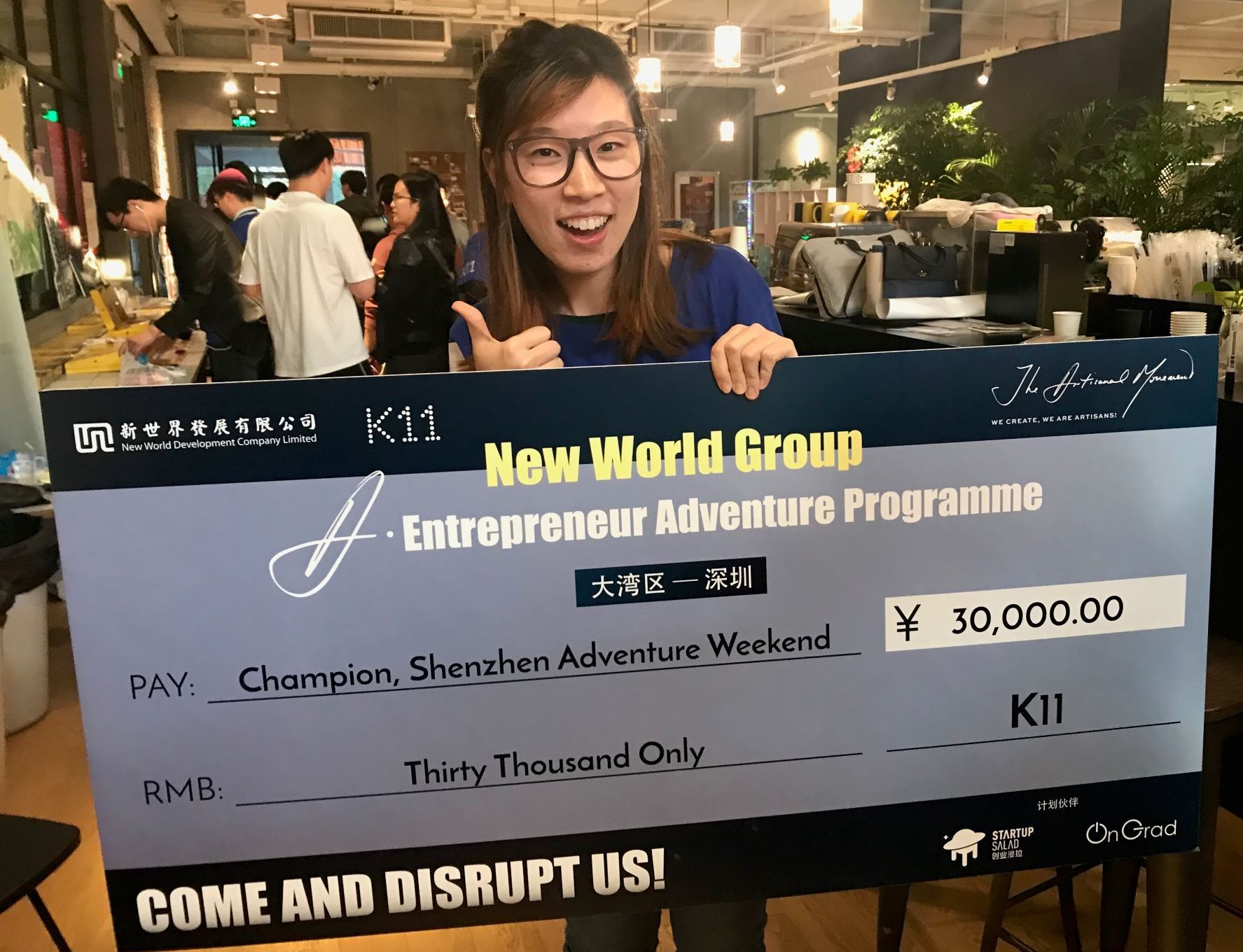
Joy was selected for New World Development Company Limited’s “A. Entrepreneur Adventure Programme” and received seed funding.
(Photo Credit: Alumna Joy Qian Xiaole)
2. Nowadays, many companies place a strong emphasis on efficiency, and the workplace is often fast-paced and highly competitive, which can create significant pressure. How do you personally view this high-pressure, and over-competitive workplace culture? When faced with stress or demanding expectations, how do you adjust yourself and support your team? Could you share an example with us?
My approach is to analyse and “dilute” the pressure before reacting. First, I identify the type of pressure. Not all pressure is negative; some drives growth, learning, and performance. The key is to distinguish between growth pressure (clear goal, supportive environment, reasonable timeline) and toxic pressure (unclear expectations, constant urgency, no recovery time, blame without ownership).
Early in my career, I was asked to run a live workshop for over 20 client executives. As a junior team member, it was intense, but it was “good pressure”: Expectations were clear, I had guidance, and time to prepare. Through rehearsal and structure, I delivered confidently. The experience showed me that discomfort is manageable with clarity, preparation, and support.
Later as a team leader, protecting my team from unhealthy pressure is part of leadership. Being a product content lead, I sometimes faced other teams pushing for impossible timelines. I supported the team by clarifying priorities, negotiating scope and timing, and aligning on what success looked like.
Overall, I don’t see competitive workplaces as something to fear—but sustainable performance requires good judgment, honest communication, and a team culture that prevents burnout.

Joy enjoys spending her leisure time outdoors, taking part in activities such as hiking, skiing and skateboarding.
(Photo Credit: Alumna Joy Qian Xiaole)

Joy enjoys spending her leisure time outdoors, taking part in activities such as hiking, skiing and skateboarding.
(Photo Credit: Alumna Joy Qian Xiaole)

Joy enjoys spending her leisure time outdoors, taking part in activities such as hiking, skiing and skateboarding.
(Photo Credit: Alumna Joy Qian Xiaole)
3. What motivated you to embark on your entrepreneurial journey? Are there any insights or lessons that you found particularly important? For students or young alumni who are interested in starting a business, what key qualities do you believe are essential for building a successful and sustainable business in today’s rapidly evolving landscape?
I’ve always been drawn to building things. As a child, I loved hands-on creative activities like directing drama and painting. Along my career journey I gravitated toward “firsts”—new projects, features, and experiments. Entrepreneurship felt like an extension of that curiosity.
In 2018, I joined “A. Entrepreneur Adventure Programme” hosted by New World Development Company Limited with friends. I didn’t hesitate because I love environments where ideas quickly become tangible. That experience helped me move from “I like creation” to “I can build something of my own”.
A key lesson from my startup journey: real motivation comes from real user impact. My startup, a photography app, encouraged people to slow down, turning photo sessions into unique printed products. Seeing users share their creations, form communities, and express gratitude reminded me that products aren’t just features; they shape habits, perspectives, and relationships. Staying user-centric isn’t just a business strategy—it’s a source of energy when things get tough.
For aspiring entrepreneurs, a few qualities matter more than a “perfect idea”:
- Emotional resilience: Setbacks are common—missed deadlines, unexpected costs, last-minute changes. You need a big heart for setbacks.
- Speed of learning: Founders constantly shift roles. The ability to learn fast is a huge advantage.
- User obsession with business discipline: Listen deeply to users—but also understand economics, sustainability, and prioritisation. A product people love must also make business sense.
- Comfort with uncertainty: You won’t always have full information. The goal isn’t to be fearless, it’s to make the best decision you can, test quickly, and adjust.
Entrepreneurship is rewarding, but it’s not “instant freedom”. It involves persistence, patience and, most importantly, passion. You will discover if you are ready once you take your first step.
